Monday, 5 March 2012

In the Museum Basement

Down in the basement of the National Museum of Scotland is a whole load of old stuff. So much so that we took two visits there to see it all properly. The exhibits down there are for the best part from the first millennium or before. 

The first picture here shows some cup and ring markings, those mysterious carvings from deep in Scotland's prehistory (and other parts of Europe too). Those of you who have been with me for a while might recognise these as things I've posted about before, for others you can see some I visited "in the wild" about a year ago here


These arrowheads, wrist guard and buckle ring were all found in a grave at Culduthel in Inverness along with a decorated ceramic pot and a few other odds and ends. The date from somewhere between 2300 BC and 1800 BC. The wrist guard is made of stone but has metal rivets.


 These two bronze blades date from 2200 BC to 1900 BC. By making a reproduction of what the knife would have looked like new, the museum have given us a far better idea of its original appearance.


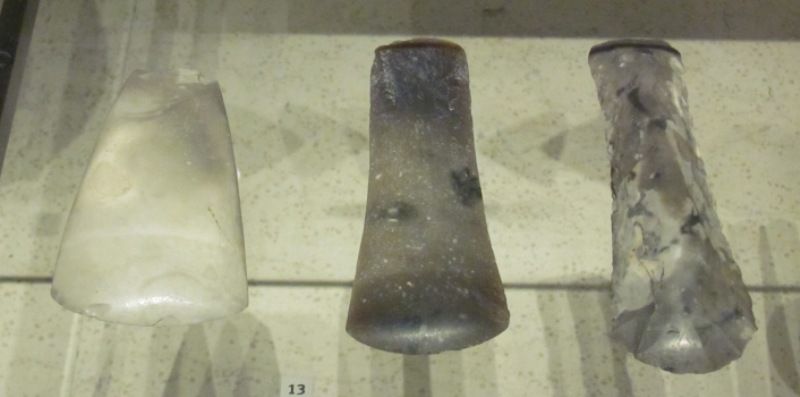
Three axeheads from 3600 BC to 3000 BC

The period covered most extensively in the basement gallery is the Roman period - they were in Britain from 43 AD (although Julius Caesar popped over for a wee look in 55 BC) till about 410 AD.  They did of course spend considerably less time in Scotland, finding us just a little...well...savage. I should point out, for the sake of international tourism, that it was a very long time ago and we're much nicer now. There are still plenty of signs of the Romans in Scotland and many artifacts have been found. I great number of those in the museum have come from the Newstead Roman fort near Melrose including this ornate bronze helmet.


Too fancy for your average legionary who would have had to make do with something along these lines, made out of iron.


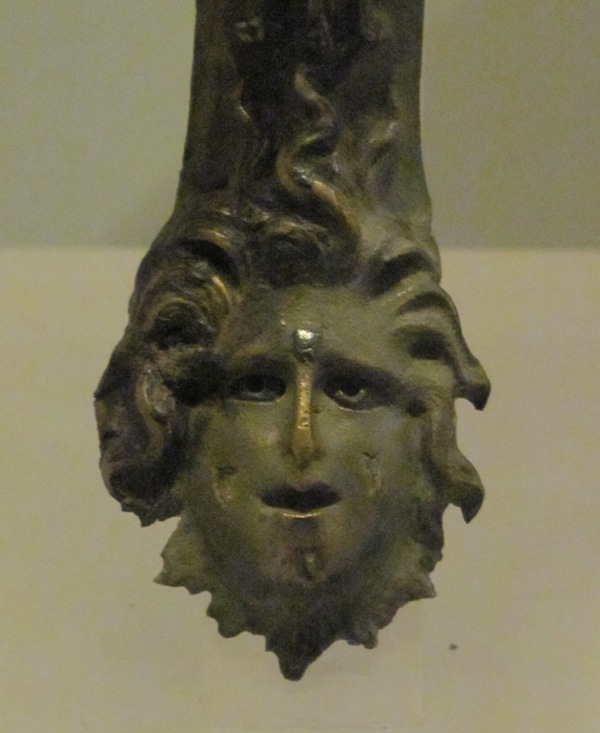
They seemed to like their decorated jug handles.


Also in the collection are everyday objects from the period - here are some oil lamps, a couple of which still show some signs of having been used.


Some very mighty nails.


This isn't the greatest picture as the camera decided it  wanted focus on something else. But if you look at the tile underneath you can see a dog has run over the tile while it was wet. Probably produced a bit  of Latin bad language from a Roman Potter.


A rather fancy spoon.


This one really caught my fancy. Who'd have thought that somebody made a folding spoon nearly 2000 years ago.


Some colourful bits of Roman bangles


A set of coins from the reign of the Emperor Trajan 98 - 117 AD. They are from left to right in descending value,an aureus, denarius, sestertius, dupondius, as, semis, and a quadrans.


This is the remains of a  carnyx found in Deskford in Moray. The carnyx is a type of iron age war trumpet that the Romans would have had to face on many of their campaigns - not just in Scotland. The Greek historian Diodorus Siculus wrote of them, "Their trumpets again are of a peculiar barbarian kind; they blow into them and produce a harsh sound which suits the tumult of war"


Based on pictures from the time and other carnyxs from elsewhere this reproduction has been made.


A little later in history, this set of scales and weights dates from around 875 to 925 AD and was found in a viking grave at Kiloran Bay on the Island of Colonsay in the Inner Hebrides.


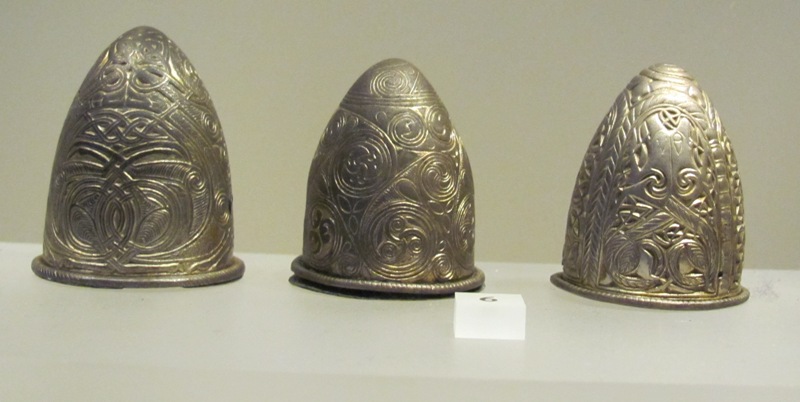
The next three pictures are all of part of the St Ninian's Isle Treasure found in 1958. They are all thought to be Pictish in origin, dating from about 800 AD and probably belonged to the church on the island who at some point have buried them for safe keeping (though perhaps not meaning to keep them safe until quite 1954). All the pieces shown here are silver gilt.

A brooch


Three objects described on the museums page as conical, in other places as mounts, and generally I don't think they really know.

The chape (the bit at the bottom) of a sword scabbard.


And almost up to date, on the way into the museum basement are these sculptures by Sir Eduardo Paolozzi (Edinburgh sculptor who lived from 1924 to 2005). They have little cabinets within them - not great for displaying things but good to look at on the whole.

Saturday, 3 March 2012

Calton Hill

This picture of Calton Hill appeared in my blog a few weeks ago and starts this blog because it's where we went for a small wander there last week. The hill along with the National and the Nelson Monuments are one of the most recognisable views of Edinburgh.

It has been suggested that the name of the hill derives from the Gaelic "chiolle-dun" (forested hill), or "cauldh-dun" (black hill). I suspect it is more romantic to think that the name comes from the Gaelic but it should be noted that a settlement on the hill appears as Caldtoun in the 1591 South Leith Parish Records ,which is obviously from the Scots for cold town, and stayed with that name pretty much until around 1700.


The National Monument of Scotland below was supposed to be a copy of the Parthenon and is a memorial to the fallen of the Napoleonic wars. The foundation stone was laid in 1822 by George IV on his visit to Scotland but construction was only started properly in 1826. Money ran out and what you see here is about how far they got. Various suggested uses for a completed version have been suggested over the years but never got further than a suggestion. What we do have looks rather good from the town (perhaps not as impressive if you go round the back of it for a look)


There is quite a selection of buildings to see on top of the hill - most of them in the enclosure of the City Observatory. In the South East corner of the enclosure, nearest to you in this picture is a monument to John Playfair, 1748 - 1819, who was professor of natural philosophy at Edinburgh University and president of Edinburgh Astronomical Institution. The green dome you see in the corner is of 20th century origin and contains a 22 inch refractor telescope


This building was built in 1812 for the Edinburgh Astronomical society which was formed in the previous year. It was designed by William Playfair, who designed many of Edinburgh's fine buildings as well as the National monument a few pictures ago. Playfair's not a common name, William was John's nephew.


The oldest building in the enclosure, in the South West corner is a one of the few surviving houses in Edinburgh designed by  James Craig in the 18th century - he was one of the planners of Edinburgh's new town.


A monument to Dugald Stewart who was professor of Moral Philosophy at Edinburgh University from 1786 till 1828 when he died.


As one of the highest places in the city, you get a cracking view. Here looking North Westish you can see the Forth Rail bridge in the distance and behind that the road bridge.


 In the other direction the largest hill in town, Arthur's Seat and the Salisbury crags. This, Calton Hill itself and the hill the castle sits on are all signs of the city's volcanic past - all be it, quite distant past.


Looking down on Hollyrood Palace at the bottom of the High Street. No royal standard flying today so the Queen is elsewhere. In the bottom right of this picture is a monument to Robert Burns, still officially on Calton
Hill.


Surely Edinburgh's most famous landmark, the castle.


You get a good view right down Princes Street from here. The clocktower on the left belongs to the Balmoral Hotel and just to the right of that is the Scott Monument which is the tallest monument to any writer in the world.


From ground level, the Omni centre at the top of Leith Walk just looks like any other modern cinema multiplex with eateries and bars, but from up here you can see they've got a rather peaceful looking roof garden.


And it's not alone, this building's got several smaller ones.


And this one's got cows!!


 Back to the hill, these pictures were taken a couple of days later, a  little distance from the hill. The tower and the building it comes from (you can't really see it here) were built between 1807 and 1815 to commemorate Nelson and his Victory at Trafalgar in 1805.


It's a building with a curious added use to it. To tell the tale we must return for a minute to the buildings of the Edinburgh Astronomical Society. One of the purposes of the society was accurate timekeeping - for which they used observation of the stars to help. Ships clocks were brought up from Leith, a few miles away, to the hill in order to get them checked. In 1854 they came up with the bright idea of the time ball. Every day it is ran up the flagpole just before one o'clock and it is dropped exactly on the hour so that ships out on the Forth could see it and set their clocks without a trek into town. A few years later in 1861 this was joined by the one o'clock gun which is fired from the castle every day. Electric wires ran from the City Observatory to both ball and gun to set them off. Nowadays, both are just tourist events and are set off by hand by somebody watching their watch.


Quite to my surprise, I managed to take a picture of the ball as it fell (I have to admit I had a few spares of the ball on the way up the flagpole just in case)

Thursday, 1 March 2012

The lost Pict.

The history of the Picts is vague. Perhaps that's a little bit of an underestimation but one of the things that they left behind are a number of carved stones from the 6th century through to the 9th century. They share a number of common patterns which nobody today knows the meaning of. As time marches into the  later centuries, you see the stones becoming increasingly christian, decorated with elaborate knotwork but they still use the mysterious symbols on the stones and mythical beasts. In a later blog I'll have several pictures of these stones but in this blog I'm off for a bit of a walk in the country with the intention of finding only one them. It's at Trusty's Hill just outside Gatehouse of Fleet and is one of the few Pictish stones to be found outside the recognised land of the Picts at the time (they mainly lived in the North east of Scotland and this is about as South West as you can get).

In the meantime, this rather toothy fellow brings us to a considerably more recent time, 1612 according to an inscription on the other side of the tomb.


The tomb was inside this ruined church which curiously is dated as 1627 - I really can't see them building a church round about such an large tomb so perhaps it some of the engraved slabs  from outside were used to make another tomb inside the church after it fell into disuse.


There may some film buffs out there who are finding this a curiously familiar churchyard. It's Anwoth churchyard and featured in the original Wickerman film. It's from here that I set off up Trusty's hill.


There's not really a lot I can say about the last few pictures, they're just a few scenes from the average assent of a small Scottish hill; a bit field with worryingly large hoof prints, a wood, a fragile dyke, some moor and a rather boggy bit (not pictured). It's a wonder I ever found my way up at all given the confusing nature of the local footpath signs.


Now that's what I'm looking for.


There is clearly a common Pictish symbol - the double disk with a z through it. To me , and indeed others, the z seems to be a broken spear having a pointy end and an end with a ball, which would have been used to help produce more force when throwing or thrusting it. You can see it featured on this page of common Pictish symbols here.


This is a bit more difficult to make out, it's what is normally referred to as a water horse. You can make out the head in the top left of the stone and the curly tail down in bottom right.


The piece of hill that this stone is on is a known iron age hill fort which may still have been used in when these stones were carved. So far away from their normal area, I would imagine that they have been made by a travelling Pict or a local who had himself travelled to the land of the Picts and seen these carvings for himself.

At the bottom of the stone, apart from a bit of recent graffiti which is why there is a cage installed over the stones, you can make out what look like a couple of  antenna coming out of a circle.


My thanks to Antonia Kearton for letting me use this photo from here Flickr page. Not only has she managed to get a much clearer picture of the carving but, when she was there, there was less moss growing on the stone and you can see a quite apparent face within the circle. This is not a known Pictish symbol.


There's a good view of Gatehouse of Fleet from up here.


 And in the other direction, past the Rutherford Monument to the sea.


I managed to avoid the bog on the way down but got rather lost instead and came out on the road about half a mile or so from the car. I did manage to see these deer though, who didn't stand around long enough for me to take more than one picture of them.