This picture of Calton Hill appeared in my blog a few weeks ago and starts this blog because it's where we went for a small wander there last week. The hill along with the National and the Nelson Monuments are one of the most recognisable views of Edinburgh.
It has been suggested that the name of the hill derives from the Gaelic "chiolle-dun" (forested hill), or "cauldh-dun" (black hill). I suspect it is more romantic to think that the name comes from the Gaelic but it should be noted that a settlement on the hill appears as Caldtoun in the 1591 South Leith Parish Records ,which is obviously from the Scots for cold town, and stayed with that name pretty much until around 1700.

The National Monument of Scotland below was supposed to be a copy of the Parthenon and is a memorial to the fallen of the Napoleonic wars. The foundation stone was laid in 1822 by George IV on his visit to Scotland but construction was only started properly in 1826. Money ran out and what you see here is about how far they got. Various suggested uses for a completed version have been suggested over the years but never got further than a suggestion. What we do have looks rather good from the town (perhaps not as impressive if you go round the back of it for a look)


There is quite a selection of buildings to see on top of the hill - most of them in the enclosure of the City Observatory. In the South East corner of the enclosure, nearest to you in this picture is a monument to John Playfair, 1748 - 1819, who was professor of natural philosophy at Edinburgh University and president of Edinburgh Astronomical Institution. The green dome you see in the corner is of 20th century origin and contains a 22 inch refractor telescope

This building was built in 1812 for the Edinburgh Astronomical society which was formed in the previous year. It was designed by William Playfair, who designed many of Edinburgh's fine buildings as well as the National monument a few pictures ago. Playfair's not a common name, William was John's nephew.

The oldest building in the enclosure, in the South West corner is a one of the few surviving houses in Edinburgh designed by James Craig in the 18th century - he was one of the planners of Edinburgh's new town.

A monument to Dugald Stewart who was professor of Moral Philosophy at Edinburgh University from 1786 till 1828 when he died.

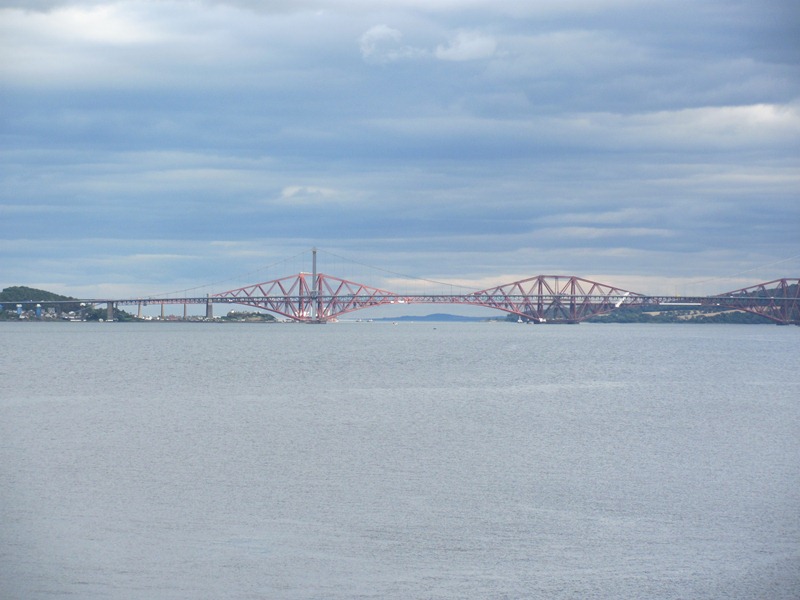
As one of the highest places in the city, you get a cracking view. Here looking North Westish you can see the Forth Rail bridge in the distance and behind that the road bridge.

In the other direction the largest hill in town, Arthur's Seat and the Salisbury crags. This, Calton Hill itself and the hill the castle sits on are all signs of the city's volcanic past - all be it, quite distant past.

Looking down on Hollyrood Palace at the bottom of the High Street. No royal standard flying today so the Queen is elsewhere. In the bottom right of this picture is a monument to Robert Burns, still officially on Calton
Hill.
Surely Edinburgh's most famous landmark, the castle.

You get a good view right down Princes Street from here. The clocktower on the left belongs to the Balmoral Hotel and just to the right of that is the Scott Monument which is the tallest monument to any writer in the world.

From ground level, the Omni centre at the top of Leith Walk just looks like any other modern cinema multiplex with eateries and bars, but from up here you can see they've got a rather peaceful looking roof garden.

And it's not alone, this building's got several smaller ones.

And this one's got cows!!

Back to the hill, these pictures were taken a couple of days later, a little distance from the hill. The tower and the building it comes from (you can't really see it here) were built between 1807 and 1815 to commemorate Nelson and his Victory at Trafalgar in 1805.

It's a building with a curious added use to it. To tell the tale we must return for a minute to the buildings of the Edinburgh Astronomical Society. One of the purposes of the society was accurate timekeeping - for which they used observation of the stars to help. Ships clocks were brought up from Leith, a few miles away, to the hill in order to get them checked. In 1854 they came up with the bright idea of the time ball. Every day it is ran up the flagpole just before one o'clock and it is dropped exactly on the hour so that ships out on the Forth could see it and set their clocks without a trek into town. A few years later in 1861 this was joined by the one o'clock gun which is fired from the castle every day. Electric wires ran from the City Observatory to both ball and gun to set them off. Nowadays, both are just tourist events and are set off by hand by somebody watching their watch.

Quite to my surprise, I managed to take a picture of the ball as it fell (I have to admit I had a few spares of the ball on the way up the flagpole just in case)