Wednesday, 8 August 2012

July Sweepings


I'm starting my July round up with a picture that was left over from June. We spotted a bit of construction going on at the top of the Mound in Edinburgh. I'll just take a wee note of it and stash it away till I find out what it becomes, I though.
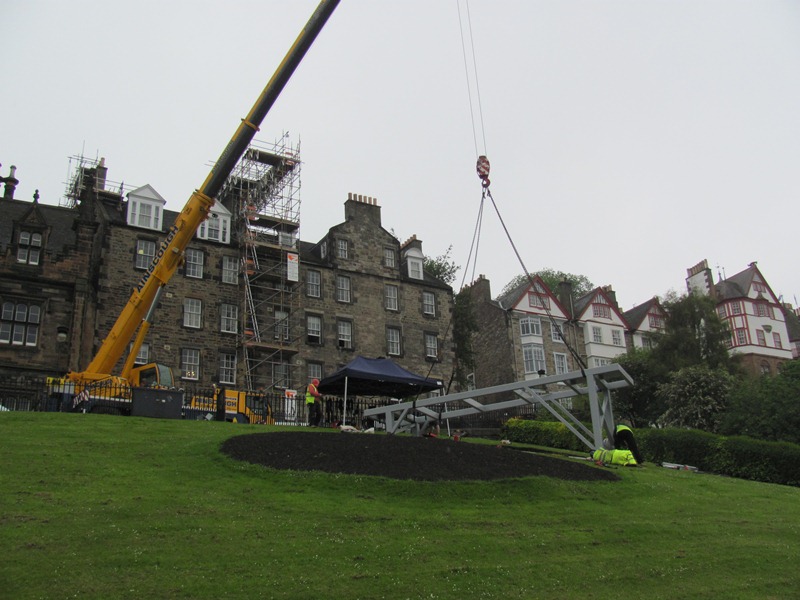

Near the beginning of the month it grew into five chunky old Olympic rings (I see a little horticulture has happened in the flower bed too)


Stepping back a little - a good couple of hundred yards away, right across the other side of Princes Street - here's how they look in the context of the town. There a couple more pictures of these at the Occasional Scotland blog who got to them first.


On our little tour north we stopped for lunch at Killin (Rolls, a banana, jaffa cakes, that kind of thing, all washed down with a nice cup of tea in the lounge of the Hotel Almera). Afterwards we went for a walk and viewed the Falls of Dockart from the bridge on the way into the town.


Early in the month I clocked this wooden head down by the harbour square.


It was advertising an exhibition of work from Colin Park (who made the head), Ian Cameron-Smith and Claire Cameron-Smith

Colin Park paints these large canvases  with stylised heads


He doesn't spare the paint.


He also made these walking sticks


This table was made by Ian Cameron-Smith.


As was this mirror.


A set of poppy prints from Claire Cameron-Smith - not from the exhibition as I thought I already had a big pile of photos of her work. Wrong again, so this is taken from the net. During last years arts and craft trail here in Kircudbright, I dropped into her studio which you can read bout here.


One of the art shops in the town had this lovely bookplate by Harold Nelson in the window. (for all you philatelists out there, Harold Nelson also designed this)


I spotted this butterfly while I was wandering up the street - much less photoshy than your average butterfly.


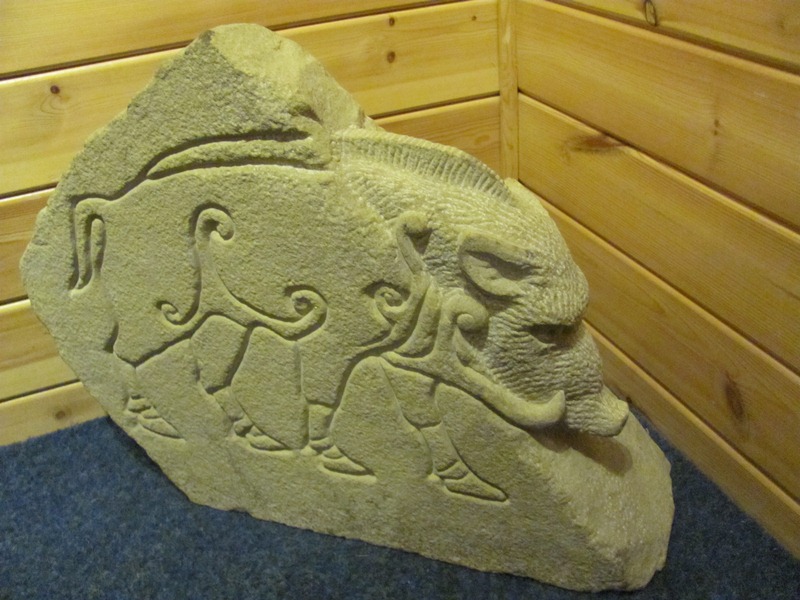
I spotted this carving at the crannog centre - I saved it for this blog as it based on a Pictish design and Pictish art dates from much later dates than the crannog, leading up to about 800AD. This, and the next piece, were completely unlabelled so I can't tell you anything about it.


I like the designs of Pictish animals but was also impressed by the way the sculptor has pushed it a little to have the more realistic boar emerging from the Pictish design.

A few miles down the road from the crannog centre I passed the Croft Moraig stone circle. It's far from a simple stone circle. Archeologists have detected three distinct periods of building at the circle starting with (like Stonehenge) a wooden circle, which of course is long since rotted away, which was replaced by a stone circle. In a third period another circle was built round the first one. There are a few extra stones in and out of the circle too. It is thought to date from about 3000BC and was in use for about 1000 years.


Occasionally my cabin at work looks out into the sunset - it makes some fine viewing before bedtime.


Saturday, 28 July 2012

Kenmore and it's kirk

I was sorting out some photos from the ones I took on my last time off for a round up blog and there was quite a pile. A large number of those were from the village of Kenmore, mainly because I liked the windows in it's church, so here it is in a wee blog of it's own.

The village of Kenmore, which was centred around Taymouth Castle, dates back to the 16th century. The main village today was laid out by the 3rd Earl of Breadalbane as a model village in 1760 and the wide street here and neat rows of cottages certainly give that impression.

You can just see the gates to the castle at the end of the village in this picture, they suggest something quite substantial beyond. I stuck my head through for a wee look but only saw a few more white washed buildings. I should have persevered and gone in because the castle itself (as I found from Wikipedia's photo later on) looks quite impressive. As far as I can see, it's not open to the public and is currently undergoing renovation as a hotel. As somebody who has recently spent three days in a tent, this is not likely to be frequented by me.


The main reason for stopping here was that the red light had come on on my tea tank. The Kenmore Hotel claims to be the oldest inn in Scotland having been established in 1572. I had to have a wee think about that as the Sheep's Heid Inn in Edinburgh edges this date by a fraction (212 years earlier) but it doesn't seem to do rooms any more which is probably key to the definition of an inn.

Inside in the lounge, I had my tea on a very interesting table. The barmaid told me that it used to be an old door but didn't know anything beyond that.


This bear sculpture outside the pub is the 2010 winner of the annual Carrbridge chainsaw carving competition. This is by Iain Chalmers who lives in a completely different part of Scotland - the Black Isle. There are several other carvings around the village. I wonder if they're all by him.


As I said, I visited the church but I completely forgot to take any pictures of it itself. I remembered later on and this was taken from across the loch at the Crannog Centre.

I found this little chap sitting (well screwed down actually) on a tree trunk just outside the church.

It has two very unusual etched windows by Anita Pate on either side of the alter.


The Pitlochry Dam - the first of these windows is to remember Alistair Duncan Millar who was the engineer on it as well as a local farmer and fisherman.

The other window celebrates the Reverend Kenneth MacVicar who was the minister here for 40 years. The building below is the manse..........

....and this is the church we are in.

An etched aeroplane in the Rev. MacVicar's window.

Outside the church, looking through one window to the other.


The church has three good stained glass windows. I'll leave you with just one of these, made in 1969 by W. Wilson RSA (I think that this is William Wilson - the information doesn't elaborate on the W)


Thursday, 26 July 2012

Crannog

I drove up to work from Dunoon this trip. On the rare occasions that I go this way, I like to drive up through the countryside rather than the recommended route of catching the ferry and going via the motorway and Glasgow. It really is the most uninspiring journey - I would go as far to say it's horrible. I had a look at my road map and picked out a couple of tasty looking National Trust for Scotland properties en routish. I'm a member, so I might as well get my money's worth. Day's don't always turn out as planned so the visits were never made.

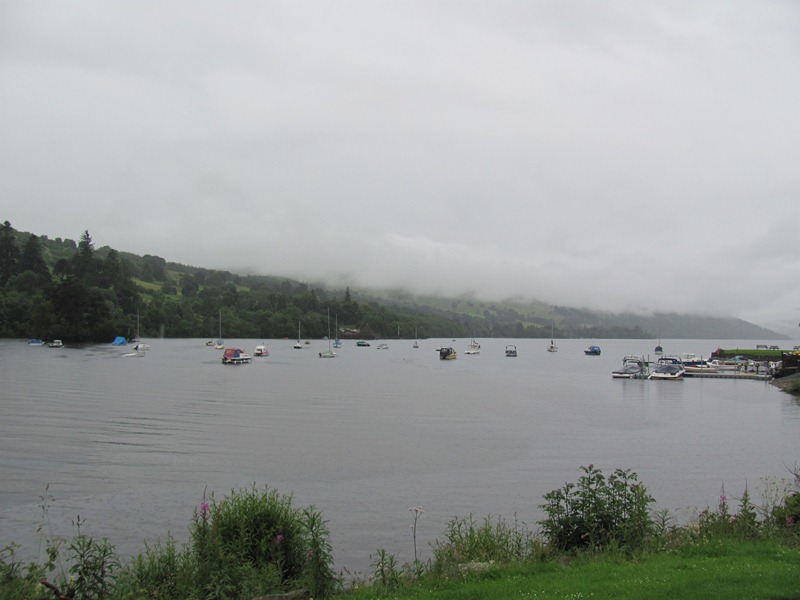
I got as far as driving up the side of Loch Tay and reached the Village of Kenmore where I reckoned it was teatime and I had a look around their wee church - very nice and more about that in my July catch up blog. Kenmore stands at the head of Loch Tay and this is the view looking out over the loch from the village.

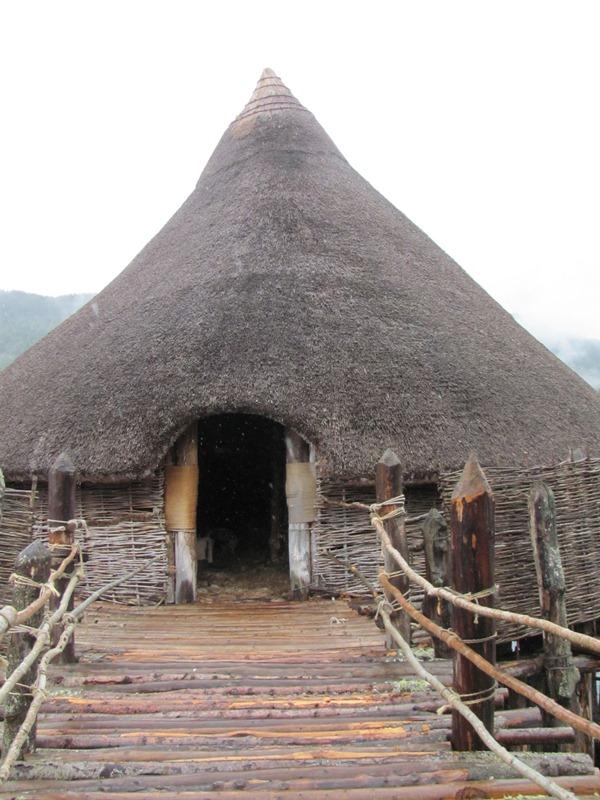
Even on a gloomy day, Scotland looks good. But there's something odd out there on the loch. If I zoom in a bit you can see for yourself. The odd looking building is a crannog, an ancient type of lake dwelling, which were built in Scotland and Ireland. In Scotland we don't of course have lakes (there is one, one natural body of water anyway, the Lake of Menteith) - we have lochs. In Ireland they call them loughs. This crannog was built by the Scottish Crannog Centre and well worth a visit I thought - I was right.

The exact definition of a crannog is a little variable and seems to cover just about any Scottish, artificially built, island dwelling from prehistory. Sometimes islands were made by building up the loch surface with rocks but others, like this one, were built by driving piles into the loch bed. There are around 350 to 500 known crannog sites in Scotland depending on what you care to call one.

These type of dwelling dates around late bronze age and early iron age, being most common in the period from about 800BC to 200BC. The sites of 18 crannogs have been found along the 14 miles of Loch Tay.

[Update: Through facebook the Scottish Crannog Centre have informed me that from multiple carbon datings of Scottish crannogs that they date back to 600 to 500 BC.] 

This crannog has, as far as possible, been built by studying the archaeological evidence gathered from the excavations of crannog sites. Much of the wood, tools, clothing and even food remains of the original loch dwellers has been preserved in the mud of the loch. The building of the crannog is in itself a piece of experimental archaeology in that much can be learned by trying to do things as our ancestors would have had to have done. The best example we were told about was in trying to get the piles into the loch bed in the first place. They archaeologists had told them what size the piles should be (they were basically sharpened tree trunks) but no amount of walloping could get them into the loch bed. They then discovered that by sitting the point of the pile in the mud and twisting it, it would end up embedded in the loch fairly quickly and with the minimum of hard work.


A walkway round the crannog.


Inside the crannog it was remarkable spacious and quite cosy at the same time. Evidence does seem to suggest that they shared it with some domestic animals. Whether you still regard it as cosy if you add a flock of sheep is all a matter of opinion (I should hope they smelt better than the flock of sheep at Arisaig a few weeks ago - phworr! they needed a bath). Evidence from the excavations tells that they had quite a balanced diet of both cultivated and foraged foods. Strangely for people living on a loch, there is no evidence of them eating any fish. Nor, incidentally, is there evidence of weapons primarily used for fighting or defending from other people - perhaps Scotland was a nice peaceful place at the time. My camera didn't do to well inside the crannog and this it the only picture even approaching focused.


The little island you see here is the site of a former crannog too. It was built up into what you see today in 1842 so that Queen Victoria, who was staying near by, and Albert might have a nice peaceful place to have a picnic. Good story but not great for archaeology.

I must give credit to our guide, Simon, who gave us an interesting, fact based tour. He said what was known, was quite candid about what wasn't know and was able to answer a range of varied questions. I'm sure the other guides are just the same.

After the crannog there was a small demonstration on ancient technology. Below we have a lathe which uses two green branches and a footpeddle to produce the energy to turn it.

There is only one green branch used as the spring for this lathe but how much greener than this could it be - it's still on the tree. We were allowed to have a shot at it after the talk - it really does work rather well.

A drill for drilling holes in a piece of rock. To be used in conjunction with some grit and a great deal of patience.

Simon demonstrated spinning some wool.


All these different colours of wool were dyed using natural substances found in the area near by. Quite an impressive range of colours in my opinion.


Grinding some flour and separating out the flour from the chaff.


Considering the dampness of the day, starting a fire without matches or a lighter or even a piece of flint seemed like quite a challenge.


Certain sorts of fungus, generally found growing on trees, when lit will smoulder for a very long time and can be used to carry an ember in them, making it possible to have your fire already with you when you stop after a days hunting, without the palaver of trying to produce an ember for yourself. The 5300 year of mummified body that was found in the alps in 1991 was carrying a piece of it, so it's been known about for some time. 

A quick look at the crannog from the loch's edge before you go, which gives a good idea how high off the water it was.